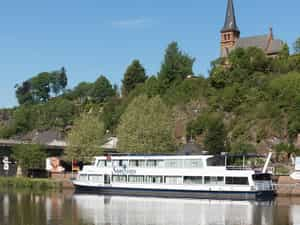
Germany Baden-Wurttemberg Cruise from Strasbourg to Remich — 9 Days

8 nights · Germany Baden-Wurttemberg · River cruise · Departs Kehl-Strasbourg (Germany) · Visiting Mannheim, Heidelberg, Mainz, Frankfurt am Main, Rudesheim am Rhein, Koblenz, Cochem, Trier, Saarburg, Luxembourg City, Remich · Aboard CroisiEurope on the ms Leonard de Vinci

CroisiEurope logo

Waterways

This river cruise sails the Rhine, Neckar, Main, Moselle and Saar, departing Kehl-Strasbourg.

  1. Rhine →
  2. Neckar →
  3. Main →
  4. Rhine →
  5. Moselle →
  6. Saar →
  7. Moselle
Cruise lineCroisiEurope
Shipms Leonard de Vinci
Duration8 nights
Port calls12
Departures4 sailings
From fare$1,291 per person
Year built2003
Guests144
Cabins72
Crew20
Length105 m
Beam11 m
Cruising speed9.0 kn
  1. Day 1

    Kehl-Strasbourg, Germany

    Strasbourg rewards visitors with a rare blend of French elegance and German character. Its historic center, the Grande Île, is a UNESCO World Heritage site, threaded with canals and half-timbered houses. At its heart, Strasbourg Cathedral rises above the old streets, its pink sandstone façade a masterpiece of Gothic architecture. Take time for a table of Alsatian cooking, where French technique meets hearty regional tradition. Then follow the riverfront lanes and discover a city shaped by centuries on Europe’s border.

  2. Day 2

    Mannheim, Germany

    Mannheim sits where the Rhine and Neckar meet, a strategic crossroads in southwestern Germany. Its orderly grid of streets gives the city an unusual character. The vast Baroque palace recalls Mannheim’s former role as a seat of the Palatinate court. See the landmark Water Tower and lively squares, then consider an excursion to Heidelberg, about 20 kilometres away. A day ashore can pair urban history with one of Germany’s best-known historic towns.

  3. Day 2

    Heidelberg, Germany

    Few German cities make history feel as immediate as Heidelberg. Set beside the Neckar, its old town gathers around the market square and the Church of the Holy Spirit. Cross the Old Bridge for views of the red sandstone castle, rising above the rooftops. Founded in 1386, Heidelberg University gives the city an enduring scholarly spirit. Walk the Philosopher’s Way for a wider view, then linger over the cafés and lanes below.

  4. Day 3

    Mainz, Germany

    Mainz is best explored on foot, where Roman foundations meet the Rhine. Begin at the cathedral, whose red sandstone towers have watched over the old town for more than a millennium. Nearby, the Gutenberg Museum celebrates the Mainz-born inventor whose printing press transformed Europe. Browse market stalls, pause in a wine tavern, or follow lanes lined with timbered houses and shops. With history close at hand and Riesling on the menu, Mainz makes a rewarding day ashore.

  5. Day 3

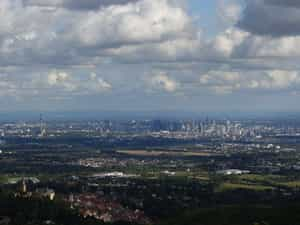
    Frankfurt am Main, Germany

    Frankfurt am Main pairs a striking skyline with the River Main and a compact historic centre. Begin at Römerberg, where half-timbered façades frame the city’s medieval square. Then cross the river to the Städel Museum, one of Germany’s leading art museums. The city rewards a longer stay. Explore the Museumsufer and sample Apfelwein in Sachsenhausen. Here, Europe’s financial capital balances modern ambition with old-world character.

  6. Day 4

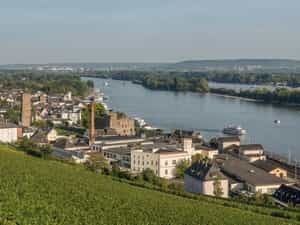
    Rudesheim am Rhein, Germany

    Rüdesheim is a rewarding first stop on the Rhine, with vineyards climbing steep slopes above the water. It stands at the southern gateway to the UNESCO-listed Upper Middle Rhine Valley, famed for castles and dramatic river scenery. Explore the old lanes and Drosselgasse, then take the cable car through the vines to the Niederwald Monument. From its hilltop setting, the Rhine spreads below in a view worth lingering over.

  7. Day 5

    Koblenz, Germany

    Koblenz stands where the Rhine and Moselle meet, beneath the watchful gaze of the Deutsches Eck. From here, river valleys, vineyard slopes and hilltop castles make an easy day’s exploration. Ride the cable car across the Rhine to Ehrenbreitstein Fortress, whose ramparts command sweeping views. The compact old town is readily explored on foot, with cafés and riverside promenades within easy reach.

  8. Day 5

    Cochem, Germany

    Cochem makes a strong first impression: Reichsburg Castle crowns a vineyard-clad hill above the Moselle. Below, half-timbered houses line narrow lanes and the riverfront. The town is small enough to explore on foot, yet its setting invites a slower pace. Taste the region’s Riesling, take a boat along the river, or visit the castle for broad views over the valley. Here, the Moselle’s pleasures are close at hand.

  9. Day 7

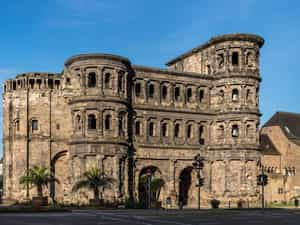
    Trier, Germany

    Trier rewards a day ashore with Roman landmarks, a handsome old town and nearby Moselle vineyards. Founded as Augusta Treverorum, it grew into one of the Roman Empire’s most important cities north of the Alps. The dark-stone Porta Nigra, Imperial Baths and amphitheatre make its past tangible; several Roman sites are UNESCO-listed. Between them, visit the cathedral and Hauptmarkt, then sample the region’s crisp Rieslings.

  10. Day 7

    Saarburg, Germany

    Few German towns put a waterfall in the middle of the old quarter. In Saarburg, the Leukbach plunges 20 metres beside half-timbered houses, mills and cafés. Walk uphill to the 10th-century castle ruins for views across red rooftops, vineyards and the Saar valley. Then follow the riverfront or browse the lanes around Buttermarkt, where the town’s compact scale makes an easy, rewarding visit.

  11. Day 8

    Luxembourg City, Luxembourg

    Luxembourg City is compact, elegant and shaped by its dramatic setting above the Alzette and Pétrusse valleys. From the old town, follow lanes past the Grand Ducal Palace to viewpoints over Grund, the historic quarter below. The city’s former fortifications, a UNESCO World Heritage site, explain its strategic importance in Europe. Set aside time for a café terrace and the striking contrast between medieval streets and modern European institutions.

  12. Days 8–9

    Remich, Luxembourg

    Remich sits on Luxembourg’s Moselle, where vineyards climb above the river and wine cellars shape local life. A level riverside promenade offers an easy introduction, with cafés, boat trips and broad views across the water to Germany. Beyond the waterfront, the Moselle wine route leads through villages and vineyard slopes known for crisp whites, Riesling and Crémant. Come ashore for an unhurried taste of Luxembourg, best explored at walking pace.

ms Leonard de Vinci Cruises

Published September 5, 2026
Last updated October 19, 2026
Author: J. Richard


Cruise Disclosure

Good to know: Prices are quoted per person based on double occupancy and include all applicable taxes and fees. Availability and prices can change quickly, so please continue through the booking process to confirm the latest availability and pricing before you pay.

We work hard to make sure everything on this website is accurate and up to date. However, some information may be incomplete or inaccurate, including details supplied by third parties or otherwise outside our control, and we cannot be held responsible for such errors. We work with 41 cruise line operators, that are providing cruises on 585 ships visiting 1,731 ports across 7,194 unique cruises, creating 13,822 itineraries. This is a great deal of data to continually update daily from our suppliers. If a pricing error, misrepresentation, or omission occurs, we reserve the right to adjust the pricing, correct the information, or cancel or decline any booking made in error, with notice to you. Thank you for your understanding!