Falkland Islands Cruise Ports & Cruise Guide
Total 2
This page is an overview of the 2 cruise ports in Falkland Islands, covering ocean cruises. 41 cruise ships visit Falkland Islands across 2 ports. See live sailings and availability on the Falkland Islands cruises page.

The Falkland Islands are a remote, windswept British Overseas Territory in the South Atlantic, offering some of the most accessible sub-Antarctic wildlife on Earth: king penguins at Volunteer Point, black-browed albatrosses on West Point Island, and elephant seals on Sea Lion Island. For the American traveler seeking milestone adventure without crowds, the Falklands are best visited on a small expedition ship that can make Zodiac landings at outer islands, not just a tender stop in Stanley. The infrastructure is minimal, the weather is demanding, and the reward is genuine wilderness.
Country facts
History
First sighted by European explorers in the 16th century, the Falkland Islands were later settled by the French, briefly by Spain, and then claimed by Britain. Argentina continues to claim sovereignty over the islands, which it calls Islas Malvinas. The 1982 Falklands War was a defining event: an Argentine invasion, a British military campaign to recover the territory, and a lasting source of tension. A 2013 referendum saw 99.8% of Islanders vote to remain a UK Overseas Territory.
The sovereignty question is not abstract. Argentina still claims the islands, and visitors will see 1982 memorials, decontaminated minefield areas, and a community deeply shaped by the war. Be sensitive when discussing the conflict, and always use 'Falkland Islands' unless an Islander suggests otherwise.
Culture
Falkland Islanders are a close-knit, overwhelmingly British-descended community with a distinct island identity shaped by farming, maritime history, and isolation. 'Kelpers' is sometimes used, but 'Islanders' is the preferred term.
Music: Pub folk and country music are popular, with strong British and Irish roots; local musicians play at Stanley's bars and community events, and there is a small but lively live-music scene.
Signature landscape: King, gentoo, rockhopper, and Magellanic penguin colonies on white-sand beaches, plus black-browed albatross colonies and the strange geological 'stone runs' of East Falkland.
Cuisine
- Freshly caught fish and chips
- Falkland Island lamb and mutton
- Seafood chowder
- Upland goose, locally hunted
- Smoko: tea and cakes at mid-morning
- Diddle-dee berry jam and blackberries
- Beer from the Falkland Islands Brewery
Architecture & heritage
- Colourful corrugated-iron houses in Stanley
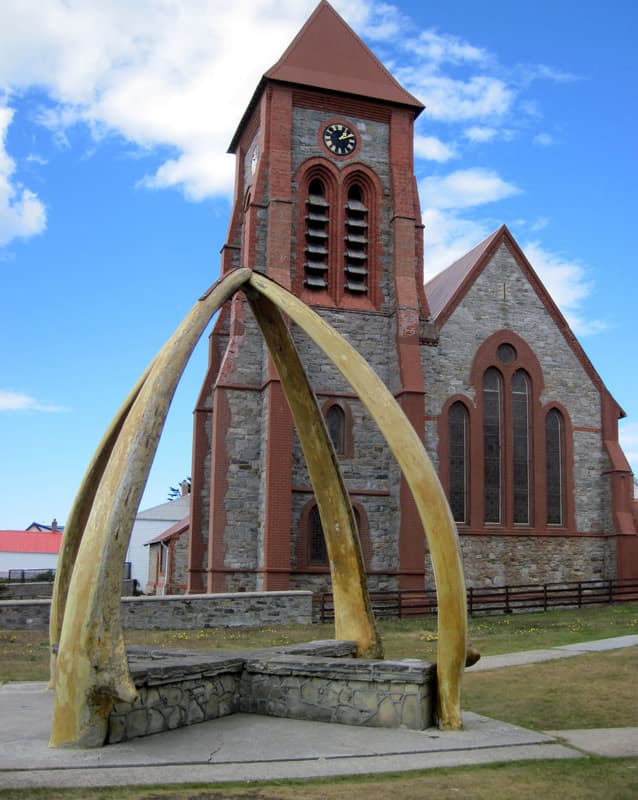
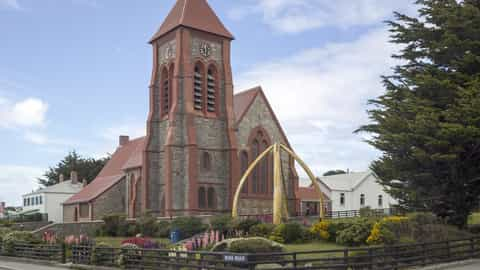
- Christ Church Cathedral and the Whalebone Arch
- Historic Dockyard Museum
- Government House
- 1982 Liberation Memorial and San Carlos Cemetery
- Working sheep farms and wool-sheds on West Falkland
Tips for American travellers
- Pack windproof and waterproof layers; weather changes in minutes and is cooler than the latitude suggests.
- Carry cash in pounds; cards are accepted in Stanley but not reliably in outer-island settlements.
- Respect farm gates, penguin colonies, and signed paths; this is working ranch land and fragile wildlife habitat.
- Book excursions through your ship or a reputable local operator; expedition landings are weather-dependent and small-ship passengers get priority.
- Avoid casually using the term 'Islas Malvinas'; the sovereignty dispute is real and personal to Islanders.
Major cities & destinations
Stanley Capital town
The only real town in the Falklands, with a colourful harbour, historic corrugated-iron houses, small museums, pubs, and easy access to wildlife on East Falkland.
The main cruise port; ships anchor in Stanley Harbour and tenders land passengers at the town jetty.
Historic Dockyard Museum Christ Church Cathedral and Whalebone Arch Government House 1982 Liberation Memorial Gypsy Cove and Yorke Bay Volunteer Point king penguin colony (day excursion)Volunteer Point Natural area / penguin colony
A remote white-sand beach with one of the most accessible king penguin colonies in the world.
The classic full-day excursion from Stanley; a 4WD drive over farmland is part of the adventure.
King penguin colony Volunteer Point beach Volunteer Point Farm and peat bogsBluff Cove & Fitzroy Coastal settlement and wildlife area
Gentoo and Magellanic penguins, king cormorants, and a windswept coastal landscape close to Stanley.
A common shore-excursion destination from Stanley, reached by 4WD across farmland.
Bluff Cove Farm Gentoo penguin colony Magellanic penguin burrows Fitzroy Settlement Coastal cliffs and kelp bedsWest Point Island Outer island wildlife sanctuary
Dramatic cliff-top colonies of black-browed albatross and rockhopper penguins, plus spectacular tussac grassland.
Expedition ships anchor off the island and make a wet or dry landing for a guided hike to the Rookery.
The Rookery West Point Island settlement Cliff viewpoints and tussac grassSaunders Island Outer island wildlife sanctuary
The Neck is one of the best landing beaches in the Falklands, shared by gentoo, rockhopper, and Magellanic penguins and black-browed albatrosses.
A classic expedition stop with a broad sandy landing at The Neck; the island is privately farmed and wildlife-rich.
The Neck Penguin colonies (gentoo, rockhopper, Magellanic) Black-browed albatross colony Saunders Island settlementCarcass Island Outer island bird sanctuary
Gentle walking, tussac grassland, sandy beaches, and some of the friendliest birdlife in the Falklands.
Often used as a sheltered anchorage for expedition ships; passengers can walk from Leopard Beach to the settlement for tea.
Leopard Beach Ponds and wading birds Settlement gardens Tussac grass and small penguin coloniesNew Island Outer island nature reserve
One of the most important seabird islands in the South Atlantic, with huge colonies of rockhopper penguins and black-browed albatrosses.
Expedition ships call at the nature reserve; boardwalks protect the fragile colonies.
New Island Nature Reserve Rookery Mount Black-browed albatross colonies New Island Museum and settlementSea Lion Island Outer island wildlife reserve
The smallest inhabited island, known for southern sea lions, elephant seals, and breeding penguins in an untouched setting.
A less-frequented expedition landing for travelers wanting solitude and ranger-led interpretation.
Sea Lion Island Nature Reserve Sea lion and elephant seal beaches Rockhopper and gentoo penguin colonies Wreck site and maritime historyCruise ports of call
The Falkland Islands have no modern cruise terminals. Most calls are made from anchored expedition ships using Zodiacs or tenders. Stanley is the only true town, while outer islands are open anchorages where the landing itself is part of the adventure.
- Antarctic & South Georgia Expedition Voyages: Ushuaia or Puerto Madryn to the Antarctic Peninsula, often with two to three Falkland Islands landings.
- South America & Cape Horn Voyages: round-trip from Buenos Aires, Punta Arenas, or Santiago that call at Stanley and outer islands as part of a broader Patagonia itinerary.
Stanley route_family_one; also route_family_two
Ships anchor in Stanley Harbour and tender passengers ashore. The town is walkable, and most East Falkland excursions depart from the jetty.
Best for: History, museums, pubs, walking, and day excursions to Volunteer Point or Bluff Cove.
Operators: Hurtigruten Expeditions, Ponant, Seabourn, Silversea, Quark Expeditions, Lindblad Expeditions, Viking Expeditions, Scenic Eclipse
West Point Island route_family_one
Expedition ships anchor off West Point Island and make a landing for a guided walk to the Rookery, where black-browed albatrosses and rockhopper penguins nest on dramatic cliffs.
Best for: Albatrosses, rockhopper penguins, and cliff scenery.
Operators: Hurtigruten Expeditions, Ponant, Seabourn, Silversea, Quark Expeditions, Lindblad Expeditions, Viking Expeditions, Scenic Eclipse
Saunders Island route_family_one
Ships anchor off The Neck, a wide sandy isthmus with penguin and albatross colonies. This is one of the most reliable wildlife landings in the Falklands.
Best for: Penguin variety, albatrosses, and sweeping beach photography.
Operators: Hurtigruten Expeditions, Ponant, Seabourn, Silversea, Quark Expeditions, Lindblad Expeditions, Viking Expeditions, Scenic Eclipse
Carcass Island route_family_one
A sheltered anchorage with an easy landing at Leopard Beach. Passengers often walk to the settlement for tea and cake while birdwatching along the way.
Best for: Birdlife, gentle walking, and the classic Falkland Islands welcome.
Operators: Hurtigruten Expeditions, Ponant, Seabourn, Silversea, Quark Expeditions, Lindblad Expeditions, Viking Expeditions, Scenic Eclipse
New Island route_family_one
A nature reserve with boardwalks protecting one of the South Atlantic's largest seabird colonies. The island's museum tells the story of early sealing and whaling.
Best for: Seabird colonies, rockhopper penguins, and conservation history.
Operators: Hurtigruten Expeditions, Ponant, Seabourn, Silversea, Quark Expeditions, Lindblad Expeditions, Viking Expeditions, Scenic Eclipse
Sea Lion Island route_family_one
A low, grassy island with no roads and few visitors. Southern sea lions, elephant seals, and breeding penguins are the main attractions.
Best for: Seals, solitude, and ranger-led walking.
Operators: Hurtigruten Expeditions, Ponant, Seabourn, Silversea, Quark Expeditions, Lindblad Expeditions, Viking Expeditions, Scenic Eclipse
Because Falkland Islands ports are mostly open anchorages rather than commercial harbours, all landings are weather-dependent and done by Zodiac or small tender. Expedition cruise directors make daily go/no-go decisions; Stanley is the only real town.
All cruise ports in Falkland Islands
Ships visiting by type: 31 ocean 7 expedition
Showing 2 ports in Falkland Islands

River cruises & routes
There is no river cruising in the Falkland Islands. The equivalent experience is small-ship expedition cruising along the coasts of East Falkland and the outer islands, where Zodiac landings replace river tenders and the wildlife is the destination.
| Route | Length | Countries | Highlights |
|---|---|---|---|
| Antarctica, South Georgia & Falkland Islands | 18-25 days | Argentina, UK (Falkland Islands), South Georgia, Antarctica | Stanley and Volunteer Point penguins, Grytviken whaling station, Antarctic Peninsula ice and wildlife |
| Falklands & South Georgia Discovery | 14-18 days | Falkland Islands, South Georgia | Outer-island albatross colonies, rockhopper penguins, historic whaling stations, king penguins at Salisbury Plain |
| Patagonia & Cape Horn with Falklands | 12-16 days | Chile/Argentina, Falkland Islands | Ushuaia, Cape Horn, Stanley, gentoo and Magellanic penguin colonies |
Season: October to March; December through February is peak wildlife breeding season and the mildest window.
Cruise lines visiting Falkland Islands
The Falkland Islands are visited almost exclusively by expedition and expedition-luxury ships. Traditional large cruise ships call only at Stanley, if at all. The lines below offer genuine landings at outer islands.
Hurtigruten Expeditions
Antarctic and South Georgia expeditions that include Falkland Islands landings; science-focused on-board programme.
Ships: MS Fram, MS Roald Amundsen
Ponant
Luxury expedition cruises from Ushuaia or Stanley to the Falklands, South Georgia, and Antarctica.
Ships: Le Commandant Charcot, L'Austral
Seabourn
Ultra-luxury expedition voyages to Antarctica and South Georgia with Falkland Islands calls.
Ships: Seabourn Venture, Seabourn Pursuit
Silversea
Expedition sailings that combine the Falklands with South Georgia and the Antarctic Peninsula.
Ships: Silver Cloud, Silver Wind
Quark Expeditions
Adventure-focused expeditions to Antarctica, often including the Falkland Islands and South Georgia.
Ships: Ultramarine, World Explorer
Lindblad Expeditions
National Geographic expedition cruises with expert naturalists and Zodiac landings at Falkland Islands wildlife sites.
Ships: National Geographic Explorer, National Geographic Endurance
Viking Expeditions
Expedition voyages to South America and Antarctica that may include Falkland Islands stops.
Ships: Viking Octantis, Viking Polaris
Scenic Eclipse
Discovery-class luxury cruises to South America and Antarctica with Falkland Islands calls.
Ships: Scenic Eclipse, Scenic Eclipse II
All are expedition or expedition-luxury lines; none of the mainstream mega-ships make routine outer-island landings because of limited infrastructure. Shore time is managed by Zodiac, not cruise-terminal gangways.
Planning & advice
For the traveler who wants meaning over crowds, the Falklands deliver small-group authenticity: penguin colonies, working settlements, and vast empty landscapes without a single souvenir chain. The expedition style gives you freedom to explore at your own pace, not follow a flag.
For the American traveller
- Passport must be valid for at least six months; US citizens do not need a visa for tourist visits, but confirm current UK entry rules before travel.
- There is no US embassy in Stanley; consular help is limited. Carry comprehensive travel insurance with emergency evacuation coverage.
- Healthcare is basic; bring prescription medicines and a personal first-aid kit.
- Wi-Fi is slow in Stanley and often absent in outer islands; plan to disconnect.
- Landmines from the 1982 war have been cleared around Stanley but remain in some remote areas; always stay on marked paths.
- The Falkland Islands pound is local; sterling is widely accepted, and US dollars are sometimes accepted in Stanley but expect change in FKP.
Excursion planning
- Book early; popular excursions like Volunteer Point can sell out.
- Choose a ship with Zodiacs for outer islands; a Stanley-only call misses the best wildlife.
- Dress in four layers and bring waterproof trousers; landings can be wet.
- Use the ship's naturalists; they know the landing zones and local regulations.
- Be flexible; weather can cancel landings even in summer.
- Take a good zoom lens; you will want 200mm or longer for penguins and albatrosses.
The verdict
A wild, wind-scoured stop that is best on a small expedition ship. The wildlife is world-class, the people are welcoming, and the lack of infrastructure is part of the charm — as long as you go with patience, proper layers, and a spirit of adventure.
Sources
- Falkland Islands Government — Falkland Islands Official Website (accessed 2026-09-09)
- Falkland Islands Tourist Board — Falkland Islands Travel Guide (accessed 2026-09-09)
- CIA — The World Factbook – Falkland Islands (accessed 2026-09-09)
- Britannica — Falkland Islands (accessed 2026-09-09)
- UK Government — Foreign Travel Advice: Falkland Islands (accessed 2026-09-09)