Faroe Islands Cruise Ports & Cruise Guide
Total 3
This page is an overview of the 3 cruise ports in Faroe Islands, covering ocean cruises. 27 cruise ships visit Faroe Islands across 3 ports. See live sailings and availability on the Faroe Islands cruises page.


The Faroe Islands are a wild North Atlantic archipelago of 18 volcanic islands, with sheer basalt cliffs, turf-roofed villages, and just over 54,000 people. Cruise calls are tender-heavy and weather-driven, so this is a destination for adventurous, flexible travelers. Small expedition and mid-size ships fit the landscape far better than large floating resorts, and the reward is an uncrowded, deeply authentic edge-of-the-world experience.
Country facts
History
The Faroe Islands were settled by Norse farmers in the Viking Age, possibly preceded by Irish hermits. Under Norwegian and later Danish control, the islands developed a distinct language and identity shaped by isolation, sheep farming, and the sea. British occupation during World War II shielded the islands from Nazi Germany and helped lead to greater self-government. The 1948 Home Rule Act made the Faroe Islands an autonomous territory within the Kingdom of Denmark.
Faroe Islands history is often presented through a romantic lens of Norse independence and isolated resilience. In reality, it is also a history of poverty, emigration, Danish bureaucratic control, and controversial whaling traditions that outsiders often misunderstand. Visitors should approach both the beauty and the complexity without expecting a simple storybook past.
Culture
Faroese identity is rooted in the Norse language, sheep farming, fishing, and a strong sense of local independence. The small population is highly literate and culturally active, with a contemporary music scene, modern art museums, and a proud chain-dance tradition.
Music: Traditional Faroese chain-dance ballads (kvæði) survive alongside world-class contemporary artists such as Eivør Pálsdóttir and Teitur. The Nordic House in Tórshavn is a hub for concerts and cultural events.
Signature landscape: The Vestmanna sea-cliffs and bird bazaars; the clifftop lake Sørvágsvatn/Leitisvatn; and Múlafossur waterfall in Gásadalur.
Cuisine
- ræst kjøt (fermented lamb)
- skerpikjøt (wind-dried mutton)
- turrur fiskur (dried fish)
- fresh Atlantic salmon, haddock, and halibut
- rhubarb, wild berries, and grass-fed lamb
Architecture & heritage
- Tinganes old town in Tórshavn with turf-roofed government buildings
- Black-tarred timber houses in Tórshavn's historic core
- Kirkjubøur's medieval Magnus Cathedral ruins
- Christianskirkjan in Klaksvík with its distinctive modern design
Tips for American travellers
- Layer clothing for wind and rain; conditions change hourly
- Book a small-ship or expedition cruise to avoid tender crowds
- Credit cards are accepted almost everywhere; cash is rarely needed
- The Faroe Islands are not in the EU; Danish kroner are used
- Driving requires ferry/tunnel awareness; many roads are single-lane with passing places
- Ask before photographing locals and respect private property
- Alcohol is sold only in licensed stores; restaurant wine lists are limited
Major cities & destinations
Tórshavn Capital city
Historic Tinganes, the Nordic House, lively harbor, and excellent seafood restaurants make Tórshavn the cultural heart of the islands.
Primary cruise gateway; most ships anchor or use a small quay in the harbor, with tenders to the town center.
Tinganes Tórshavn Cathedral Nordic House Skansin Fortress Listasavn Føroya (Faroe Islands National Gallery)Klaksvík Town
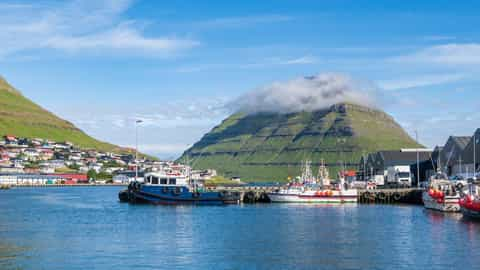
The second-largest town in the Faroe Islands, Klaksvík is a working fishing port and the gateway to the dramatic northern islands of Kalsoy, Viðoy, and Borðoy.
Second main cruise port after Tórshavn, with a deep-water quay in some weather conditions.
Christianskirkjan Klaksvík Church Kalsoy island ferry terminal Northern Isles mountain sceneryVágar (Sørvágur/Miðvágur) Island/airport gateway
Vágar is home to Vágar Airport, the famous lake above the ocean (Sørvágsvatn/Leitisvatn), and the stunning Múlafossur waterfall at Gásadalur.
Occasional tender anchorage for expedition ships; more often reached by road excursion from Tórshavn.
Sørvágsvatn/Leitisvatn Múlafossur waterfall Gásadalur village Vágar tunnelVestmanna Village and boat tour base
Vestmanna is the departure point for unforgettable boat trips into the towering Vestmanna bird cliffs and sea caves.
Excursion destination from Tórshavn rather than a regular deep-water cruise port.
Vestmanna bird cliffs Sea caves and rock arches Kalsoy views across the soundKirkjubøur Historic village
The most important medieval site in the Faroe Islands, Kirkjubøur contains the ruins of Magnus Cathedral and the old farmstead Kirkjubøargarður.
Just a short drive from Tórshavn, so it is a standard shore excursion stop.
Magnus Cathedral ruins Kirkjubøargarður farm St. Olav's ChurchEysturoy (Runavík/Fuglafjørður) Island region
Eysturoy offers dramatic fjord scenery, the highest mountain in the Faroe Islands (Slættaratindur), and the famous village of Gjógv.
Small fjord ports are occasionally used by expedition ships; the island is also a scenic transit route between Tórshavn and Klaksvík.
Eysturoyartunnilin (subsea tunnel) Slættaratindur mountain Gjógv village and natural harbor Runavík harborCruise ports of call
The Faroe Islands are a port-of-call destination rather than a homeport. Most cruise calls use Tórshavn and Klaksvík, with occasional anchorage in Vágar or smaller fjord harbours. Weather, wind, and fog can reroute or cancel tender operations, so flexibility is essential. Facilities are basic but welcoming, and shore excursions tend to be small-group, scenic, and low-key.
- North Atlantic Expedition: Iceland, Faroe Islands, Greenland and Canadian Maritimes
- British Isles & Norway Coastal: Scotland/Shetland to Faroe Islands and Norway
Tórshavn Both route families
The main cruise port and the easiest place to explore Faroese culture. Tenders usually land near the old town, allowing passengers to walk to Tinganes, the cathedral, and the harbor. The port area is compact and safe.
Best for: History, culture, harbor walks, and easy independent exploration
Operators: Hurtigruten Expeditions, Viking Ocean Cruises, Seabourn, Ponant, Silversea
Klaksvík Both route families
Klaksvík is a working fishing town surrounded by steep mountains. Its harbor is more sheltered than Tórshavn's in some winds, and it provides the best access to the northern islands, especially Kalsoy.
Best for: Northern island scenery, Kalsoy lighthouse, local fishing culture
Operators: Hurtigruten Expeditions, Viking Ocean Cruises, Seabourn
Vágar (Sørvágur) North Atlantic Expedition
Used mainly by expedition ships to access Vágar Island, Sørvágsvatn/Leitisvatn, and Múlafossur waterfall. Not a large-scale cruise port; shore-side infrastructure is minimal.
Best for: Vágar scenery, lake-above-the-ocean hike, Gásadalur waterfall
Operators: Hurtigruten Expeditions, Ponant
Other small fjord harbours, including Runavík, Fuglafjørður, and Tvøroyri, may appear on expedition itineraries. Infrastructure is limited and shore-side facilities are modest, but these calls reward travelers with even quieter landscapes and a stronger sense of everyday Faroese life.
All cruise ports in Faroe Islands
Ships visiting by type: 26 ocean 1 expedition
Showing 3 ports in Faroe Islands


River cruises & routes
There are no navigable rivers in the Faroe Islands. The equivalent experience is coastal/expedition cruising around the archipelago, often as a segment of a larger North Atlantic voyage. These are ocean itineraries, not river journeys.
| Route | Length | Countries | Highlights |
|---|---|---|---|
| Iceland to Scotland via Faroe | 7-9 | Iceland, Faroe Islands, Scotland | Reykjavík, Tórshavn, Klaksvík, Shetland/Orkney |
| Norway, Faroe & Iceland Expedition | 12-14 | Norway, Faroe Islands, Iceland | Bergen, Tórshavn, Vágar, Reykjavík |
| British Isles & Ireland to Iceland | 14-16 | United Kingdom/Ireland, Faroe Islands, Iceland | Edinburgh or Dublin, Kirkwall, Tórshavn, Heimaey |
Season: Mid-May to early September; June and July offer the longest daylight and best seabird colonies, but weather is always unpredictable.
Cruise lines visiting Faroe Islands
Small and mid-size expedition and ocean cruise lines dominate Faroe Islands itineraries. Large mega-ships are rare because of tender capacity, narrow fjords, and environmental sensitivity.
Hurtigruten Expeditions
Norway–Iceland–Greenland expedition voyages with Faroe calls
Ships: MS Maud, MS Fram
Viking Ocean Cruises
British Isles/Iceland itineraries including Tórshavn
Ships: Viking Star, Viking Mars
Seabourn
Northern Europe and Iceland voyages with Faroe ports
Ships: Seabourn Quest, Seabourn Sojourn
Ponant
North Atlantic expedition itineraries
Ships: Le Bellot, Le Commandant Charcot
Silversea
Arctic and British Isles voyages
Ships: Silver Moon, Silver Wind
Schedules change frequently. Verify port calls, tender arrangements, and shore excursion availability directly with the cruise line before booking.
Planning & advice
For a milestone traveler who hates being herded, the Faroe Islands offer a raw, uncrowded edge-of-the-world experience: tiny villages, puffin cliffs, and almost no souvenir kiosks. Expedition-style cruising is the most dignified way to see them—no mega-resort atmosphere, no forced fun, and plenty of silence.
For the American traveller
- US citizens do not need a visa for short tourist visits, but confirm entry rules with Danish authorities before travel.
- Credit cards are widely accepted; ATMs are limited outside Tórshavn and Klaksvík.
- Mobile coverage is good in towns but absent in remote valleys; check with your carrier about international plans.
- Most cruise passengers visit for only a day, so book shore excursions early and be prepared for weather-related changes.
- Serious medical cases may require evacuation to Denmark; carry comprehensive travel insurance.
- Pack layers, waterproof footwear, and windproof outerwear even in summer.
- Expect wind, rain, fog, and sudden changes; patience is essential.
Excursion planning
- Book ship excursions for tender priority; independent guides may not meet you at anchorage.
- Choose hikes according to fitness; paths are wet, steep, and often slippery.
- Bring binoculars for seabirds, whales, and dramatic cliff views.
- Expect small-group minibuses, not large coaches.
- If a port is missed due to weather, ask about scenic cruising alternatives.
The verdict
Best visited on an expedition or small-ship voyage with flexible weather plans, paired with Iceland or Scotland. Not a beach destination, but a profound landscape for travelers who value silence, wind, and authenticity.
Sources
- CIA World Factbook — Faroe Islands (accessed 2026-09-09)
- Visit Faroe Islands — Practical Information (accessed 2026-09-09)
- Government of the Faroe Islands — About the Faroe Islands (accessed 2026-09-09)
- Hurtigruten Expeditions — Faroe Islands Cruises (accessed 2026-09-09)
- Wikipedia — Faroe Islands (accessed 2026-09-09)