Laos Cruise Ports & Cruise Guide
Total 2
This page is an overview of the 2 cruise ports in Laos, covering river cruises. 3 cruise ships visit Laos across 2 ports. See live sailings and availability on the Laos cruises page.


Laos, the 'Land of a Million Elephants,' offers a serene, unspoiled river journey along the Mekong. For the discerning American traveler aged, this is a counterpoint to mass tourism—a chance to experience authentic Buddhist culture, French-colonial heritage, and breathtaking natural landscapes at a gentle pace. River cruising here is intimate, with small ships and personalized service, ensuring you never feel herded. From the UNESCO-listed town of Luang Prabang to the enigmatic Plain of Jars, each stop reveals a layer of Laos's soul. This package presents a complete profile, including ports, excursions, and a curated image plan, to craft an unforgettable milestone voyage.
Country facts
History
Laos has a rich history as the ancient kingdom of Lan Xang ('Million Elephants'), founded in 1353. It later fragmented into three kingdoms. French colonization in the 19th century shaped its architecture and administration. After a turbulent period of civil war and the Pathet Lao takeover in 1975, Laos became a communist state, but has since opened to tourism and economic reform.
The country remains politically controlled, but tourism is welcomed. Many unexploded ordnance (UXO) from the war remain in rural areas; stick to cleared paths and guided tours.
Culture
Lao identity is deeply tied to Theravada Buddhism and the Mekong River. Respect for elders, gentle demeanor, and 'sabai sabai' (take it easy) reflect a relaxed lifestyle. The baci ceremony, a soul-calling ritual, is a signature experience.
Music: Lao classical music features the khaen (mouth organ), a UNESCO-listed intangible heritage. Traditional lam vong dancing is common at festivals.
Signature landscape: The Mekong River—lifeline of Laos, with waterfalls, rapids, and riverine communities. Also the Kuang Si Falls near Luang Prabang.
Cuisine
- Laap (minced meat salad with herbs and lime)
- Tam mak hoong (spicy green papaya salad)
- Khao niao (sticky rice, staple)
- Or lam (Luang Prabang stew)
- Sai oua (Lao sausage)
- Mekong whiskey (Lao-Lao)
Architecture & heritage
- Wat Xieng Thong (Luang Prabang) – finest temple in Laos
- Pha That Luang (Vientiane) – national symbol
- French colonial wooden houses in Luang Prabang
- Plain of Jars (Xieng Khouang) – prehistoric megalithic jars
- That Ing Hang (Savannakhet) – sacred stupa
Tips for American travellers
- Dress modestly when visiting temples (cover shoulders, knees).
- Remove shoes before entering temple buildings and private homes.
- Do not touch anyone's head; feet are considered lowly.
- Negotiate prices gently; bargain with a smile.
- Carry small kip notes for offerings (alms) to monks.
- The alms giving ceremony in Luang Prabang is sacred – observe quietly, do not flash cameras in monks' faces.
Major cities & destinations
Luang Prabang UNESCO World Heritage City
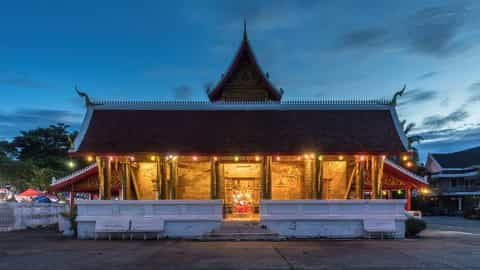
The jewel of Laos – a serene town of gilded temples, French colonial architecture, and vibrant night market. It is the spiritual heart of the country and a mandatory stop on any Mekong cruise.
Primary embarkation/disembarkation point for Mekong cruises in Laos; ships anchor along the river within walking distance to town.
Wat Xieng Thong Royal Palace Museum (Haw Kham) Mount Phousi (for sunrise/sunset views) Kuang Si Falls (excursion) Alms giving ceremony (Tak Bat) at dawn Night Market on Sisavangvong RoadVientiane Capital City
A sleepy, charming capital with a mix of Lao and French colonial influences. Notable for its temples, monuments, and riverside promenade.
Often a pre/post cruise extension; also a port on some itineraries along the Mekong, though most cruises end at Luang Prabang.
Pha That Luang Wat Sisaket Haw Phra Kaew (former Emerald Buddha temple) Patuxai (Victory Gate) Cope Visitor Centre (UXO awareness)Pakse Gateway to Southern Laos
Gateway to the Bolaven Plateau and the 4,000 Islands (Si Phan Don) region. A base for exploring the serene south.
Occasionally visited by cruises on the lower Mekong (from Cambodia); provides access to Wat Phou.
Wat Phou (UNESCO World Heritage) Bolaven Plateau waterfalls (Tad Fane, Tad Yuang) Champasak Historical Heritage Museum The 4,000 Islands (Si Phan Don) – don't miss if timeXieng Khouang (Phonsavan) Provincial town
Home to the mysterious Plain of Jars, a UNESCO World Heritage Site candidate. A step back in time with war history.
Not directly on the Mekong; accessible by road from Vientiane or Luang Prabang. Not a typical cruise port but a possible land extension.
Plain of Jars (multiple sites, especially Site 1) UXO Visitor Centre Mulberry Tea Plantation Local Hmong villagesCruise ports of call
Mekong river cruises in Laos operate between Huay Xai (near Thailand border) and Luang Prabang, or further south to Vientiane and Pakse. The ports are mostly riverside landings with minimal infrastructure; shore excursions are via small boats and buses.
- Upper Mekong: Huay Xai – Pakbeng – Luang Prabang (2-3 days)
- Lower Mekong: Luang Prabang – Vientiane – Pakse – Cambodia (7-10 days)
Huay Xai route_family_one
Entry point from Thailand (Chiang Khong). Small riverside town; cruise ships often start here. It is also a hub for slow boats to Luang Prabang.
Best for: Beginning of an upper Mekong cruise; glimpse of the border town life.
Operators: Pandaw, Heritage Line, Mekong Sun Cruises
Pakbeng route_family_one
An overnight stop for the classic slow boat trip between Huay Xai and Luang Prabang. Cruise ships anchor here; a hilltop village with a lively market.
Best for: Overnight stay to break the journey; cultural walk up to the village temple.
Operators: Pandaw, Mekong Sun Cruises, Avalon Waterways
Luang Prabang route_family_one & route_family_two
The main cruising hub in Laos. Ships dock near the royal palace. The town is walkable; tuk-tuks available.
Best for: Major exploration: temples, museums, waterfalls, and the famous night market.
Operators: Pandaw, Heritage Line, Avalon Waterways, Emerald Cruises
Vientiane route_family_two
Riverside capital; ships anchor on the Mekong. A mix of modern and colonial. Good for city tours.
Best for: Historic monuments, Buddhist temples, and French-influenced architecture.
Operators: Pandaw, Avalon Waterways
Pakse route_family_two
A southern city on the Mekong; access to the Bolaven Plateau and Wat Phou. The port is functional but not glamorous.
Best for: Excursions to Wat Phou and waterfalls; also a connection to Cambodia.
Operators: Pandaw, Heritage Line, Mekong Sun Cruises
Other potential stops include: Tha Khhaek (for Konglor Cave), Savannakhet (colonial charm), and 4,000 Islands (Don Khon) – but these are less common for luxury cruises and may be included as optional land extensions.
All cruise ports in Laos
Ships visiting by type: 3 river
Showing 2 ports in Laos
River cruises & routes
River cruising in Laos is almost exclusively on the Mekong River. Vessels range from traditional wooden boats to contemporary small ships (max ~50 passengers). Cruises typically combine Laos with Thailand, Cambodia, and Vietnam.
| Route | Length | Countries | Highlights |
|---|---|---|---|
| Huay Xai to Luang Prabang (Upper Mekong) | 2–3 nights | Laos (starting from Thailand's border) | Pakbeng village, tribal encounters, stunning river scenery, Luang Prabang's temples. |
| Luang Prabang to Vientiane (Central Mekong) | 4–5 nights | Laos | Paklay, Vang Vieng (optional), capital city tours. |
| Vientiane to Pakse & Cambodia (Lower Mekong) | 7–10 nights | Laos, Cambodia | Wat Phou, 4,000 Islands, Phnom Penh (Cambodia). |
Season: October to March (dry season) is the best time; water levels are moderate, temperatures cooler. July to September can have high water and heavy rain, but still possible.
Cruise lines visiting Laos
Several premium and boutique cruise lines operate in Laos. They emphasize cultural immersion, small ships, and included excursions. No mass-market lines (like Royal Caribbean) operate here.
Pandaw
Classic Laos itineraries: Huay Xai to Luang Prabang, and onward to Vientiane; also combined with Cambodia and Vietnam.
Ships: Pandaw River Explorer, RV Mekong Pandaw
Heritage Line
Boutique cruises on the Mekong, focusing on upper and lower Laos; overnight options in Luang Prabang.
Ships: Heritage Line Anouvong, Heritage Line Manohra
Avalon Waterways
Mekong River itineraries from Cambodia to Laos, often ending at Luang Prabang.
Ships: Avalon Siem Reap, Avalon Saigon
Emerald Cruises
Vietnam & Cambodia to Laos, with extensions to Luang Prabang and Vientiane.
Ships: Emerald Harmony
Mekong Sun Cruises
Charters and specialty cruises on the Mekong, including Laos sections.
Ships: Mekong Sun
These lines are known for all-inclusive pricing (except for a few optional excursions), small ships (20-60 passengers), and intimate service. They are ideal for mature travelers who prefer authenticity over lavish amenities.
Planning & advice
Laos offers an unhurried, contemplative travel experience that resonates with travelers seeking meaningful encounters without being herded. The river cruise format is inherently small and personal, with local guides who provide deep insight. It's a safe, serene country with a rich spiritual heritage, and the lack of mass tourism ensures you feel like a guest, not a tourist.
For the American traveller
- Visa: Available on arrival for most nationalities, but it's safer to get an e-Visa in advance.
- Health: Vaccinations recommended (hepatitis A/B, typhoid); malaria risk in some rural areas – consult a travel clinic.
- Money: ATMs exist in cities, but cash (LAK or US$) is king; small denominations essential.
- Safety: Laos is generally safe; political sensitivity – avoid discussing government; UXO risk only in designated rural zones.
- Etiquette: Always ask permission before photographing people, especially monks and children.
- Internet: Wi-Fi is available in hotels and ships, but may be slow.
- Power: Plugs are the same as US (two-prong), but voltage is 230V – check your devices.
Excursion planning
- Book shore excursions through your cruise line to ensure quality and safety, especially in remote areas.
- Wear comfortable walking shoes – many sites have uneven terrain.
- Bring modest clothing for temple visits; your cruise line will remind you.
- Stay hydrated; carry bottled water on excursions.
- Be respectful during almsgiving – keep a distance and follow your guide's instructions.
- Consider the 'low season' (May-September) for fewer crowds but expect rain.
The verdict
Laos is a must for the curious, culturally-engaged traveler who values authenticity and serenity. While infrastructure is modest, the country's charm lies in its simplicity. A Mekong river cruise is the best way to see Laos – it combines comfort with immersion, and the small scale of the ships prevents that 'herded' feeling. Perfect for a milestone trip that will be remembered for its beauty, people, and spirituality.
Sources
- CIA World Factbook — Laos - The World Factbook (accessed 2026-09-09)
- Lonely Planet — Laos travel guide (accessed 2026-09-09)
- UNESCO — Town of Luang Prabang (accessed 2026-09-09)
- Mekong River Commission — Mekong River Navigation (accessed 2026-09-09)
- Pandaw — Laos Cruise itineraries (accessed 2026-09-09)
- Heritage Line — Laos Cruises (accessed 2026-09-09)