Saint Barthélemy Cruise Ports & Cruise Guide
Total 1
This page is an overview of the 1 cruise ports in Saint Barthélemy, covering ocean cruises. 42 cruise ships visit Saint Barthélemy across 1 ports. See live sailings and availability on the Saint Barthélemy cruises page.

Saint Barthélemy is a small, chic French Caribbean island that has traded mega-resorts and cruise terminals for privacy, natural beauty and an unhurried sense of luxury. The capital, Gustavia, is the heart of yachting and island life, while beaches such as Colombier, Saline and Grand Cul-de-Sac remain remarkably wild. This package is built for mature, independent American travelers who want beauty without crowds and a destination that feels curated rather than packaged.
Country facts
History
Saint Barthélemy was inhabited or visited by Arawak/Taino peoples before Columbus arrived in 1493. The French settled in the 17th century, then traded the island to Sweden in 1784. Sweden made Gustavia a free port and gave the island its most distinctive architectural chapter. France bought it back in 1878 and administered it as part of Guadeloupe until 2007, when it became a separate overseas collectivity. Tourism, private aviation and yachting transformed the island in the late 20th century, while the island's old French-Caribbean families maintained a strong sense of place.
St. Barth's modern prosperity is tied to luxury tourism and yachting. This has protected the coastline from overbuilding but has also made housing expensive for many local workers. Visitors should treat the island's environment and community with care rather than treating it as a private playground.
Culture
A proud, discreet French Caribbean island with deep roots among families descended from 17th-century French settlers. Swedish street names and the harbor of Gustavia recall the Swedish era, while the island's contemporary identity is shaped by yachting, art galleries and a love of quiet beaches. Residents value politeness, discretion and independence.
Music: Zouk, kompa and reggae are common, along with French Caribbean carnival music. The island also hosts the St. Barth Music Festival, a classical and jazz festival in January, and live music appears at beach bars, regattas and seasonal celebrations.
Signature landscape: The Grand Cul-de-Sac lagoon: a broad, shallow turquoise lagoon protected by a barrier reef, ideal for paddleboarding, windsurfing and gentle sailing; nearby, the trail to Colombier offers one of the most scenic coastal hikes in the Caribbean.
Cuisine
- Accras de morue – crisp salt-cod fritters
- Langouste grillée – grilled Caribbean spiny lobster with butter and lime
- Tourment d'amour – a small tart filled with coconut and rum, a St. Barth specialty
- Soupe de poissons – saffron fish soup with rouille and croutons
- Crabe farci – stuffed land crab
- Colombo de poulet – curry-inspired chicken stew
- Fresh mahi-mahi, conch, local vegetables and tropical fruit
Architecture & heritage
- Gustavia's crescent harbor lined with red-roofed warehouses and former Swedish-era buildings
- Fort Gustav and Fort Karl ruins overlooking Gustavia
- The Swedish bell tower and the old town grid of Gustavia
- Traditional St. Barth houses with corrugated metal roofs, wooden shutters and small gardens
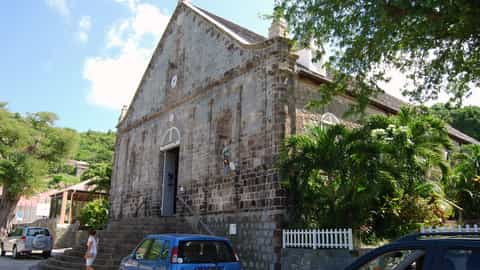
- Lorient's early church and old cemetery reflecting the island's settlement history
Tips for American travellers
- Start with 'bonjour' before speaking English; it is appreciated even in tourist areas.
- Carry euros for small purchases; credit cards are widely accepted but some markets and bakeries are cash-only.
- Pack reef-safe sunscreen, a cover-up, and comfortable walking shoes for forts and trails.
- Dress is 'beach chic,' not formal; few restaurants require jackets.
- Reserve dinner tables in high season, especially January through March.
- Renting a Mini Moke or small 4x4 is the best way to explore, but roads are narrow, steep and sometimes unpaved.
Major cities & destinations
Gustavia Capital town and harbor
The historic and social heart of St. Barth, with a yacht-filled harbor, Swedish-era streets, art galleries, duty-free shops, forts and excellent restaurants.
The only true cruise and ferry port of call; ships anchor or moor in the outer harbor and tender passengers into the inner harbor.
Fort Gustav ruins and panoramic harbor viewpoint Fort Karl and the headland view over Gustavia Swedish bell tower (Le Clocher) Musée Territorial de Saint-Barthélemy – local history in a Swedish-era house Shell Beach (Anse de Grand Galet), a short walk south of townSaint-Jean Beach village and airport hamlet
Most visitors' first taste of the island; the Gustaf III Airport runway ends beside the beach, and Baie de Saint-Jean is lined with boutique hotels, restaurants and water sports.
Not a commercial cruise port, but a scenic bay often used by private yachts and tenders in settled weather; the airport is the main arrival point for guests flying from Sint Maarten.
Baie de Saint-Jean Gustaf III Airport beachside runway overlook Eden Rock headland, a St. Barth landmark Saint-Jean beach shops and watersports areaGrand Cul-de-Sac Lagoon and windsurfing beach
A protected turquoise lagoon on the island's northeast side, with calm water, reef snorkeling, beach restaurants and a relaxed, family-friendly atmosphere.
Popular shore excursion by boat or car from Gustavia; occasional yacht anchorage at the edge of the lagoon.
Grand Cul-de-Sac lagoon and barrier reef Anse de Grand Cul-de-Sac beach Pointe Milou lookout (nearby) Seagrass beds and calm shallows ideal for paddleboardingCorossol / Flamands / Colombier Traditional fishing village and north-shore beaches
See old St. Barth: Corossol is a tiny fishing hamlet known for straw-work artisans; Flamands is a wide white-sand beach; Colombier is reached by boat or hike and offers excellent snorkeling in a wild cove.
Not a port, but a favorite area for island tours and private boat excursions from Gustavia.
Corossol village and straw-hat artisans Flamands beach Anse de Colombier (by boat or hiking trail from Flamands) Coastal trail viewpoints above ColombierSaline / Gouverneur Wilder southern beaches
For travelers who want empty beaches and dunes. Saline is a protected beach with no development; Gouverneur is a beautiful crescent often uncrowded, reached over a low hill.
Often included in private shore excursions; accessible by 4x4 or minibus from Gustavia.
Saline Beach (Anse de Grande Saline) Grande Saline salt pond Gouverneur Beach (Anse du Gouverneur) Hilltop viewpoints over the southern coastÎle Fourchue Uninhabited islet and nature reserve
A rocky, arid islet northwest of Gustavia, part of the Saint-Barthélemy Nature Reserve. Its protected bay offers excellent snorkeling, swimming and total escape.
A favorite yacht anchorage for day charters; no dock or infrastructure, only clear water and anchorages.
Crescent anchorage bay Snorkeling trail along the rocky shoreline Summit hike with 360-degree views of St. Barth, Saba and St. Martin Underwater seagrass and coral habitatsCruise ports of call
St. Barth is not built for large cruise ships. Calls are made by small luxury ships and private yachts. The main port and anchorage is Gustavia, where vessels either moor in the outer harbor, anchor off the harbor and tender passengers to the quay, or tie up at the small commercial/fuel pier at the north end of the harbor. The absence of a deep-water cruise terminal keeps the island low-key and crowd-free.
- Leeward Islands small-ship route: Sint Maarten – St. Barth – St. Kitts – Nevis – Antigua
- Luxury yacht charter route: St. Barth loops around Gustavia, Île Fourchue, Colombier and Grand Cul-de-Sac, with possible day stops at Saba and St. Eustatius
Gustavia Leeward Islands small-ship route (route_family_one) and luxury yacht charter route (route_family_two)
Ships anchor or moor in the outer harbor and tenders bring passengers into the inner harbor near the Quai du Général de Gaulle. The harbor is compact; guests walk into town in minutes. Larger yachts may use the commercial/fuel pier at the north end.
Best for: First-time visitors, walking history, boutique shopping, dining, art galleries and booking island tours.
Operators: Windstar Cruises, Seabourn, SeaDream Yacht Club, Ponant, Ritz-Carlton Yacht Collection, Star Clippers
The nearest large international airport is Princess Juliana International Airport (SXM) on Sint Maarten, about a 10-minute flight or a 2-3 hour ferry ride from Gustavia. Regional ferries from Sint Maarten and Guadeloupe use the same Gustavia quay. There is no industrial cruise terminal; all passenger movements are small-scale.
All cruise ports in Saint Barthélemy
Ships visiting by type: 41 ocean 3 expedition
Showing 1 port in Saint Barthélemy
River cruises & routes
St. Barth has no rivers and no river cruise industry. The equivalent travel experience is small-ship coastal or yacht cruising among the Leeward Islands, with St. Barth as a signature stop. This section is therefore framed around the island's role in those itineraries.
| Route | Length | Countries | Highlights |
|---|---|---|---|
| Leeward Islands small-ship voyage | 7 nights | Sint Maarten, Saint Barthélemy, St. Kitts & Nevis, Antigua and Barbuda | Gustavia harbor, St. Kitts' Brimstone Hill, Nevis' Charlestown, Antigua's Nelson's Dockyard |
| Luxury yacht charter around St. Barth | 7 nights | Saint Barthélemy (Gustavia, Île Fourchue, Colombier, Grand Cul-de-Sac), with possible day stops at Saba and St. Eustatius | Gustavia, Île Fourchue snorkeling, Colombier beach, beachside lunches, sunset sails |
Season: Mid-December through April is the high season, with settled trade winds and the best beach weather. May-June and November are shoulder months with lower prices, though some restaurants close. June-November is Atlantic hurricane season, though St. Barth is often south of the worst storm tracks.
Cruise lines visiting Saint Barthélemy
Because St. Barth has no deep-water cruise terminal, calls are generally made by small luxury ships, sailing yachts and expedition-style vessels. The port is a tender stop or yacht anchorage, not a pier for mega-ships.
Windstar Cruises
Caribbean Leeward Islands; often includes St. Barth on 7-14 day itineraries from Sint Maarten or Barbados.
Ships: Wind Surf, Wind Spirit, Wind Star
Seabourn
Small-ship Caribbean voyages; St. Barth appears on some winter itineraries; tendered.
Ships: Seabourn Quest, Seabourn Ovation, Seabourn Sojourn
SeaDream Yacht Club
Yachting-style Caribbean cruises; calls at St. Barth as part of Leeward Island circuits.
Ships: SeaDream I, SeaDream II
Ponant
French-owned expedition/yacht cruises in the Caribbean; often includes Gustavia.
Ships: Le Lapérouse, Le Bellot, Le Paul Gauguin (seasonal)
Ritz-Carlton Yacht Collection
Luxury yacht itineraries in the Caribbean; St. Barth calls vary by season.
Ships: Evrima, Ilma
Star Clippers
Tall-ship sailing cruises in the Leeward Islands; anchors at Gustavia.
Ships: Star Flyer, Royal Clipper
Deployments change annually, and no single line guarantees a St. Barth call. Verify with the line or a trusted travel advisor. In addition to scheduled cruise lines, private yacht charter operators use St. Barth as a base or stop, which is how many visitors experience the island.
Planning & advice
St. Barth is a destination for milestone travelers who prefer discovery over crowds. It is small enough to explore at your own pace, sophisticated enough for a celebratory dinner, and quiet enough to feel like a private escape. The island rewards independent travelers who would rather sit at a beachside table with a glass of chilled wine than queue for a tender.
For the American traveller
- U.S. citizens need a valid passport; no visa is required for short tourist stays, but check current French and U.S. government guidance before travel.
- Travel insurance with medical evacuation is strongly recommended; on-island medical facilities are limited and serious cases are transferred to Guadeloupe or Sint Maarten.
- There is no U.S. embassy on the island; know the nearest U.S. Embassy or Consulate and enroll in the State Department's STEP program.
- Credit cards are widely accepted, but carry euros for small vendors and markets; ATMs are concentrated in Gustavia and Saint-Jean.
- Cell service is good in town, but some coves and trails have no signal; download maps and confirm pickup times.
- Emergency number in French territories is 112; the local hospital is the Centre Hospitalier de Bruyn in Gustavia.
- Do not expect mega-resort amenities; St. Barth is intimate, quiet and expensive.
Excursion planning
- Book shore excursions through your ship or a reputable local operator; independent taxis and guides are excellent but not inexpensive.
- For a non-herding experience, skip large group island tours and charter a private boat for the day; anchor at Colombier and Île Fourchue.
- Beach days are best in the morning; trade winds build in the afternoon.
- If you want history, start in Gustavia early before the boutiques open; the forts are free and uncrowded.
- Reserve lunch at Grand Cul-de-Sac or Flamands in high season; popular restaurants fill quickly.
- Agree on taxi fares in advance; taxis are not metered.
The verdict
Saint Barthélemy is best for travelers who value privacy, scenery, history and good food over big-ship entertainment. It can feel expensive and weather-dependent, but for a milestone journey the combination of turquoise water, yachts, historic Gustavia and empty beaches is quietly spectacular.
Sources
- Comité Territorial du Tourisme de Saint-Barthélemy — Saint Barth Tourism – Official Tourism Board (accessed 2026-09-09)
- CIA World Factbook — Saint Barthelemy (accessed 2026-09-09)
- Wikipedia — Saint Barthélemy (accessed 2026-09-09)
- France.fr — Saint Barthélemy – Official French Tourism Portal (accessed 2026-09-09)
- U.S. Department of State — France Travel Advisory (accessed 2026-09-09)